If you’ve ever tried to get a firmware project off the ground using a complex microcontroller, you know the real challenge doesn’t always lie in writing code, it lies in understanding the system well enough to write the right code.
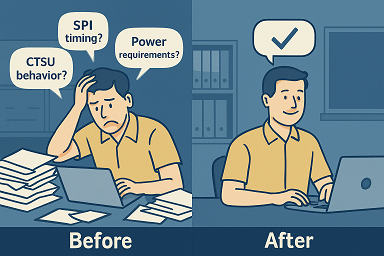
And that starts with a mountain of documentation.
Datasheets, application notes, reference designs, timing diagrams, electrical characteristics, register maps, protocol specs… all critical, all essential, and, let’s be honest here, overwhelming.
For one recent project, I found myself buried in a stack of PDFs just to answer what should’ve been a few straightforward questions. The Renesas RA6M3 is a feature-rich part: 120 MHz Arm Cortex‑M4, rich with peripherals, dual-bank flash, TrustZone security, and high-speed connectivity. It’s a great chip, but working with it means juggling a lot of technical detail across multiple documents which are formatted differently and often light on context.
And in embedded systems, missing even one detail – a timing requirement, a power caveat, a mismatch in voltage domains, can cost you days, or worse, cause failures in the field.
That’s where NotebookLM changed everything for me.
Turning a Paper Avalanche into a Precision Tool
Rather than flipping endlessly through 100+ pages of PDFs, I used NotebookLM to ingest all of the RA6M3 documentation. Everything from the primary datasheet to the application notes on touch sensing and USB integration.
Once the documents were in, the workflow shifted. I wasn’t skimming, cross-referencing, or second-guessing anymore. I was asking focused questions and getting precise, source-cited answers.
Here are a few examples of how it immediately improved velocity and confidence:
“What are the max current draw specs for USB-HS under worst-case conditions?”
NotebookLM returned a clean, cited list showing exact values from different operating modes which helped me validate power supply design choices in minutes, not hours.
“Extract all the SPI timing constraints and compare them with my selected NOR flash part.”
This query produced an actionable checklist. It highlighted edge cases I might’ve missed, like minimum hold times that weren’t obvious from the flash vendor datasheet.
“Which GPIO ports support interrupt-on-change and how are they configured?”
Instead of sifting through peripheral descriptions and register maps, I received a summarized list of interrupt-capable pins, their configuration registers, and even links to relevant usage notes in the FSP docs.
“What’s the minimum Vdd required for full-speed operation at 120 MHz?”
NotebookLM parsed the electrical characteristics table and flagged operating voltage ranges, and actually caught a cautionary spec from the footnotes, something that’s often missed on a first read-through.
“Summarize the DMA channel limitations when used with SCI and SPI peripherals.”
This helped me understand which DMA triggers were shared, which channels were blocked under certain clock configurations, and what conflicts I needed to avoid during peripheral mapping.
“Highlight all peripherals that can wake the MCU from Software Standby mode.”
NotebookLM assembled a list based on multiple sections scattered across the datasheet. Perfect for low-power applications where wakeup sources matter deeply.
Why This Matters in Real-World Projects
In the embedded world, documentation is both your blueprint and your minefield. Getting it wrong means missed deadlines, failed prototypes, or hours lost to vague errata and undocumented behavior.
NotebookLM gave me a way to interact with complex documentation the way I think: contextually, precisely, and without the noise.
In projects where I’m brought in to accelerate development or rescue a struggling codebase, I’ve seen firsthand how the lack of deep understanding of timing requirements, peripheral edge cases, or electrical characteristics which leads to fragile firmware. Using tools like NotebookLM, I can bring that understanding forward early in the process, avoiding expensive rework and missed milestones.
A Better Way to Build Embedded Systems
At the end of the day, tools like NotebookLM aren’t a magic fix but they are a force multiplier. When paired with deep embedded experience, they allow for faster onboarding, cleaner architectures, and fewer surprises downstream.
If your team is ramping up on a new microcontroller, needs a fresh set of eyes on a tough integration problem, or is just tired of spinning cycles wading through documentation instead of delivering product value, let’s talk.
Because the future of embedded development isn’t about memorizing 120-page datasheets. It’s about finding clarity faster and building things that work, reliably and on time.
